FREE sourcing support for qualified business buyers, with an eligible benefit of up to 3%. Eligibility applies to qualified business buyers and is confirmed after we review your product, quantity, destination, and sourcing requirements.

Bulk shoe care assortments planned for multiple buyer channels

CHANNEL REQUIREMENTS

Bulk Shoe Care for Defined Buyer Use Cases

The same broad product family can require different application formats, packaging, assortment ratios, label content, and acceptance checks. State the channel and actual footwear materials before requesting an offer.

APPLICATION ROUTES

Translate channel context into measurable quote fields

Each route below is a procurement scenario, not a performance claim or customer case. Values remain buyer-defined or supplier-confirmed.

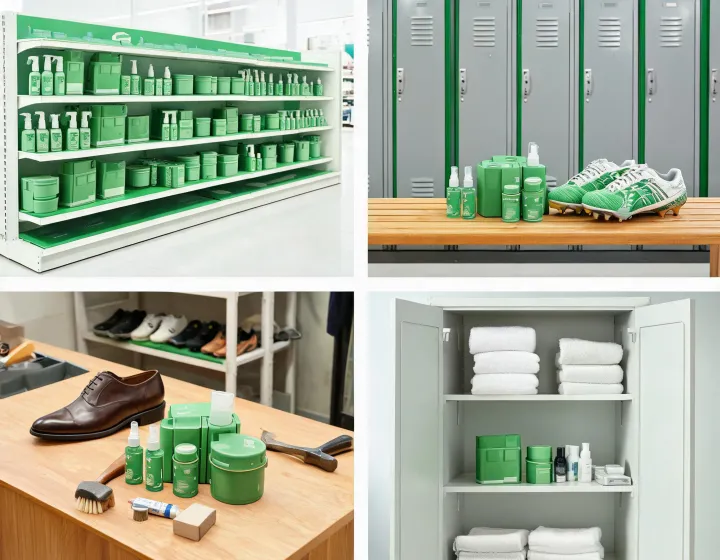
RETAIL

Footwear stores and ecommerce assortments

Map the target footwear categories and shelf architecture. Specify whether the line needs separate cleaners, brushes, cloths, protectors, deodorizers, laces, insoles, or complete kits. Ask for fill or unit size, pack dimensions, barcode and label responsibility, master-carton ratio, assortment quantity, display requirements, and product-specific documentation.

SPORT

Teams, clubs, and training facilities

Describe shared or individual use, indoor or outdoor footwear, soil type, cleaning location, storage, replenishment rhythm, and kit custody. Require the supplier to identify surface exclusions and application instructions for the exact proposal. Do not infer athlete safety, antimicrobial effect, material protection, or treatment performance from a generic family description.

SERVICE

Repair shops and footwear care counters

List technician steps, substrate range, dispensing format, brush stiffness or cloth construction, refill unit, labeling, and waste-handling questions. A professional-use claim does not replace formula-specific information or a controlled sample check. Record whether a quotation includes applicators, containers, closures, retail packaging, or only bulk contents.

PROGRAM

Hospitality, corporate, and promotional kits

Define recipient profile, pack contents, branding, artwork revision, presentation box or pouch, insert copy, quantity by color or kit, delivery destinations, and approval sequence. If sustainability language is requested, ask what exact material, content, test, or chain-of-custody evidence supports the proposed wording; avoid broad environmental conclusions.
Three trade-offs to document openly

Broad compatibility vs. substrate-specific care

A multi-surface claim can simplify assortment, while a substrate-specific product may provide narrower instructions. Neither route is assumed suitable; ask for exact intended surfaces, exclusions, directions, and sample checks.

Lower unit price vs. equivalent pack scope

A loose brush, an empty private-label bottle, and a filled retail kit are not comparable units. Normalize pieces, net quantity, contents, packaging, tooling, freight, and exclusions before calculating procurement cost.

Family documents vs. exact-item evidence

A product-family document can guide questions but does not establish the formula, material, packaging, revision, or manufacturing source of the quoted item. Record the link between each document and proposal.

Use-case RFQ checklist

  • Footwear use and each upper, midsole, outsole, trim, or hardware surface
  • Product format, material or formula constraints, fragrance and color questions
  • Fill volume, dimensions, pieces per set, size system, and quantity by variant
  • Application, storage, labeling, artwork, retail pack, and carton ratio
  • US destination, requested timing, freight scope, and total-order budget basis
  • Exact-item sample relation, documents, unresolved questions, and approver

Any chemical, hazard, transport, performance, environmental, or compliance conclusion requires review of the exact proposed item by an appropriate qualified party.

Match the quotation to the channel, not just the product name

Send the intended use, product mix, pack unit, variant quantities, destination, timing, and evidence questions.